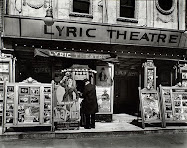
Sometimes a horror flick will depend upon things like jump-scares in order to try to shock its audience. You know the kind of thing I mean: the lights have gone out in the heroine's house, she's trying to find a candle, opens up a closet door, and out jumps a screeching cat that has apparently not before made a sound in protest of being trapped in there. Others rely on special effects to show us all kinds of creepy crawly aliens or ghosts that appear and disappear and attack both the viewer and the protagonist. For an especially egregious example of this, see the 1999 remake of The Haunting which turns one of the great psychological thrillers of the 60's into a showcase for bad and ill-considered cgi effects. Then there are the movies which rely on creating an atmosphere in order to provide their chills and thrills, movies which set the hero or heroine in a situation that seems just slightly off-kilter and then slowly turn up the oddness until there is no denying that something strange is going on and they must eventually confront whatever is causing it. Today's film, Carnival of Souls, fits squarely into the latter category.
Conceived when director-producer Herk Harvey was vacationing in Salt Lake City and became enamored of the abandoned Saltair Pavilion on the banks of the Great Salt Lake, Carnival of Souls tells the story of Mary Henry, a young organist who is abbout to take a job at a church in a new town. Before leaving for her new position, however, Mary is out with some friends, and they are challenged to a drag race by a car full of boys. Pulling onto a bridge, the girls' car is bumped by the other and goes careening over the edge. Police and rescue workers show, and depite their best efforts they cannot find the car or any survivors in the depths of the river. Suddenly, however, Mary appears crawling onto the bank, and it's deemed a miracle that she survived.
She may have survived the wreck, but something has changed about Mary. Moving to her new job she declares that she is never coming back to her old town, and when she gets to the new one she seems cold and distant from people, having trouble fitting in. She has also begun to have visions of a pale old man, at first just taking over her reflection, but eventually appearing before her in physical form. She is having other visions too. On her way to the town she noticed an old abandoned amusement park, and not only does she feel strangely drawn to it, but she seems to be having waking dreams of ghouls dancing and cavorting through the park. Most disturbing of all, however, is the change in Mary's music. Once described by the minister who has become her boss as music to move the soul, he is soon denouncing it as profane and blasphemous. Soon, Mary has no coice but to investigate the old carnival and see what significance it has in what has happened to her.
Filmed on a reported budget of $33,000, in and around Salt Lake City and Lawrence, Kansas, using mostly local actors and actresses, Carnival of Souls is surprisingly effective with its otherworldly atmospherics and mounting sense of dread. It's one of those films that gives you that creeping sense of "something's not quite right here, but I'm not sure exactly what it is".
Here's a trailer:
And the Skinny:
Title: Carnival of Souls
Release Date: 1962
Running Time: 82min
Black and White
Starring: Candace Hilligoss
Directed by: Herk Harvey
Produced by: Herk Harvey
Released by: Herts-Lion International corp.
Ah, the classic case of mistaken identity. I suppose it's been a staple of storytelling ever since there have been stories. The classic greek play Oedipus Rex hinges on a tragic case of mistaken identity, as does Shakespeare's Two Gentlemen of Verona. Today's police procedurals and soap operas alike take full advantage of look-alikes and evil twins. And classsic westerns were no stranger to the formula either, though today's film does put an interesting kink in the idea. In The Fargo Kid, though our protagonist is mistaken for a well-known gunman, it's not so much because he looks like the bad guy, but because he is riding a horse that he won from him in a duel.
Tim Holt, the star of today's feature, was a mainstay in westerns from is first appearance in 1928's The Vanishing Pioneer until his last in 1952's Desert Passage. In all, he racked up, according to IMDB some 75 credits, including the role he is probably best known for, starring opposite Humphrey Bogart in The Treasure of the Sierra Madre.
In The Fargo Kid, Holt plays, perhaps not surprisingly, The Fargo Kid, who wins a sorrel horse from gunslinger Deuce Mallory. Unfortunately for Fargo, not only does Deuce's reputation precede him but so does the look of his horse. When he arrives in Micaville, Fargo finds himself the center of a number of conspiracies. He is hired (as Deuce) to kill a prospector who is close to a gold strike. The local sherrif has also identified Fargo as Mallory and intends to arrest him. Then there is the real Mallory, who intends to not only kill Farogo but retrieve both the horse and $5000 that Fargo got with it.
Let's take a quick look at The Fargo Kid, shall we?
Oh, wait. That was the wrong Fargo, wasn't it? Alright, then, let's try this one:
Hrmmm... still the wrong Fargo. Darn this whole mistaken-identity thing. It can muck everything up. Ok, One more try:
Ah, the heck with it - let's just get on with the Skinny:
Title: The Fargo Kid
Release Date: 1940
Running Time: 63min
Black and White
Starring: Tim Holt
Directed by: Edward Killy
Produced by: Bert Gilroy
Released by: RKO Radio Pictures
The Fargo Kid can be watched or downloaded for free here.
It doesn't appear to be available on DVD at this time.
Until next time, Happy Treasure Hunting,
-Professor Damian
Just a short update to point out some of the new buttons over there on the right hand side. Yep, your ol' Professor is now on Facebook and Twitter and also writing for BlogCritics. To become a fan on Facebook, you can just click the button over there, or you can visit my Facebook page by clicking here. To get updates and more on Twitter, again just click the button or click here to visit my profile. Finally, check out my first BlogCritics article here, and look for more soon.
Ok, we now return you, to your regularly scheduled blog...
Since I talked about the origins of the TV show Dragnet the other day in discussing the film He Walked By Night, I thought today I'd share with you one of the episodes that is now in the public domain. From season 5, here's episode 9:
There are quite a few episodes available to watch or download for free at Archive.org. Just click here.
There are also a number of collections on DVD available from Amazon. Here's one: Dragnet - Volumes 1-6 (6-DVD).
And here's a Netflix link, too:Dragnet 4.
Until next time, Happy Treasure Hunting,
-Professor Damian
Ah, getting older. Sometimes it's not easy to accept. Especially for celebrities, it seems. Look at all the money that is spent each year by famous folk still trying to maintain the image of youth. Are they doing for themselves, out of vanity? Or are they doing it because we, as their public, don't want them to change from the image of them that we hold in our hearts? Of course, growing older is something that simply can't be avoided, and with it can come changes that simply can't be denied. Hair loss, weight gain, lack of movement - all of these can be byproducts of the aging process. And all oof them can change not only the public's perception of us, but our perception of ourselves.
Still, aging is something that cannot be avoided (well, in this life, at least). And that's true even if one is a well-known lothario with a reputation for smoothness and virility among the women. And that's the situation our protagonist finds himself in today. Don Juan is a man well known for his charisma with the ladies. He's also a man whose reputation has sparked a number of impersonators claiming to be the famous lover. he's also a man becoming tired of trying to live up to his reputation, so when one of those impersonators is killed, the true Don Juan also takes the opportunity to retire.
Of course, when a person has become accustomed to fame, it can be hard to figure out how to carry on without it. Eventually finding that the only lover he can get now is a scullery maid, Don Juan has has enough. However, reclaiming his fame when he has grown older and no longer looks like the dashing young man the public imagines him to be may be beyond the prowess of even this legendary lover.
This was Douglass Fairbanks Sr.'s last film, and in some ways brings his legend full circle as well as that of the character he is portraying. One can certainly feel that this is a bit more than just a role to the now 51-year-old Fairbanks who, like his filmic counterpart, may no longer have the physical moves to play some of the roles he once did, still has an actor's heart and soul, and he definitely brings them to this role.
Instead of a trailer today, I'm going to give you part one of a documentary on the life of Douglas Fairbanks Sr. The documentary was produced by Delta Entertainment with the assistance of the Douglas Fairbanks Museum. It runs about 90 minutes and was released by the museum on Youtube, and is also available on DVD from the museum. It's definitely interesting viewing, and I encourage you to click on through and watch the rest.
And now, the Skinny:
Title: The Private Life of Don Juan
Release Date: 1934
Running Time: 89min
Black and White
Starring: Douglas Fairbanks, Sr. , Merle Oberon
Directed by: Alexander Korda
Produced by: Alexander Korda
Distributed by: United Artists:
A beautiful girl meets a handsome man while they are both on a cruise. they fall in love, even though each is engaged to marry someone else. They agree to ditch their current loves and meet six months later at the top of the Empire State Building. On the way to the planned rendezvous, however, she is struck by a car and paralyzed. Rather than tell him of her condition, she simply lets him think that he has been stood up. Fate, however, has other plans.
If that sounds like a synopsis of a movie you remeber and brings to mind 1994's Love Affair starring Warren Beatty and Anette Bening, well, first of all, I'm sorry for reminding you of that movie but it's not too surprising. If, on the other hand, it sounds to you like the plot of 1957's An Affair to Remember, which starred Cary Grant and Deborah Kerr, then at least I can say you have better taste in films than those 1994 people, and again it's not too surprising. There is one other option, though. If what I wrote above reminds you of 1939's Charles Boyer / Irene Dunne film Love Affair, well, then let me compliment the diversity of your movie viewing and admit that I am pretty surprised.
Yes, today's film is the original. And a very good movie it is. It was actually nominated for seven Academy Awards, including Best Picture, Best Actress, Best Supporting Actress, and Best Writing. Unfortunately (well, unfortunately for this film, but fortunately for movie lovers), 1939 was an incredible year for movies as it was up against (among others) The Wizard of Oz, Goodbye, Mr. Chips, Mr. Smith Goes to Washington, Of Mice and Men, and Best Picture winner Gone With the Wind. In succeeding years it has also unfortunately been overshadowed by the 1957 remake. (Let's just all agree to forget the 1994 version, shall we, except perhaps to note its being awarded that year's Razzie for Worst Remake.) Which is actually the better film? Well, there can be no denying the presence and charm that Grant brings to the screen, but in some ways, I almost find Boyer and Dunne more convincing as lovers.
How about if instead of a trailer today, we take a look at the same scene (well, pretty much, anyway) from both movies:
And now, the Skinny:
Title: Love Affair
Release Date: 1939
Running Time: 87min
Black and White
Starring: Charles Boyer, Irene Dunne
Directed by: Leo McCarey
Produced by: Leo McCarey
Distributed by: RKO Radio Pictures
(Just to be clear, only the 1939 version of Love Affair is in the public domain. An Affair to Remember and the 1994 remake are both still under copyright.)
Love Affair is available to watch or download for free here.
It's also available to purchase on DVD from Amazon: Love Affair
It's also available for rental or to "watch instantly" at Netflix: Love Affair.
Until next time, Happy Treasure Hunting,
-Professor Damian
THIS IS A TRUE STORY. It is known to the police department of one of our largest cities as the most difficult homicide case in its experience, principally because of the diabolical cleverness, intelligence and cunning of a completely unknown killer... The record is set down here factually ---- as it happened ---- only the names are changed ---- to protect the innocent.
If the above opening sounds somewhat familiar, kiddies, then there's probably a reason for that. Today's flick, He Walked By Night, was the film that inspired Jack Webb to create the series Dragnet.
In 1948, Webb was coming off of the success of his radio show Pat Novak for Hire in which he portrayed an unlicensed private detective with a penchant for lines like "She drifted into the room like 98 pounds of warm smoke. Her voice was hot and sticky--like a furnace full of marshmallows." He had also begun to do some film acting, and was offered the role of a crime lab technician in He Walked By Night. the movies was based on the actual shooting of a California Highway Patrolman. Shot in a semi-documentary style, the film was made with the co-operation of the Los Angeles Police Department who sent Detective Sergeant Marty Wynn to the set to be a consultant. Webb and Wynn struck up a friendship, and over the course of the film, Webb had the idea that a radio show featuring the life of a Los Angeles police detective which was as true-to-life as possible and which would have episodes based on actual cases might prove popular. Taking the idea to NBC, he actually had something of an uphill battle, but eventually won them over, and the radio Show Dragnet premiered in 1949, lasting until 1954. In 1951, the show expanded, making the move to television, where it would last until almost the end of the decade.
The movie itself is actually quite good, even if it has been overshadowed by what came after. A fine example of noir filmaking, including some very dark and angular camera work by noted noir cinematographer John Alton, it contains quite a few twists during its 79 minutes. Roy Morgan, a brilliant man with an inside knowledge of police procedure, shoots and kills a patrolman named Hollis. Morgan is also a thief who steals electronics equipment and then sells it to a dealer named Paul Reeves. When the police raid Reeves store, Morgan is almost caught. he escapes, but not before shooting another officer and taking a bullet himself. Deciding to try something new in hopes of throwing the police off his trail, Morgan becomes an armed robber, but when they recover a slug from one of his robberies, forensics specialist Lee (Webb) is able to connect it to Morgan's other crimes. From there it is all downhill for the criminal.
There's not a good embedable trailer online for the flick, so instead, I'm gonna give you another Jack Webb treasure from an appearance on Johnny Carson's Tonight Show:
And now, the Skinny:
Title: He Walked By Night
Release Date: 1948
Running Time: 79 min.
Black and White
Starring: Richard Basehart
Directed by: Alfred L. Werker, Anthony Mann
Produced by: Bryan Foy, Robert Kane
Distributed by: Eagle-Lion Films
He Walked By Night is available to watch or download for free here.
Amazon has the movie available for purchase on DVD: He Walked By Night.
Netflix also has the DVD available for rental: He Walked by Night.
Until next time, Happy Teasure Hunting,
-Professor Damian
Y'know, in baseball, a double is a good thing. Depending on which side you're on, a double play can also be a very good thing. Best of all, though, especially for the fans, is a double-header. Unfotunately, I don't think anyone in today's flick is going to be trying out for the majors anytime soon. Which means in this case a double header is simply double trouble.
In The Incredible 2 Headed Transplant, Bruce Dern (yes, really, that Bruce Dern) plays a doctor who is obsessed with the concept of transplanting heads. Why? Well, from what yer Ol' Professor can tell it's because Dern's Dr. Girard just swallowed a whole bottle of why-the-hell-not pills. He's already been kicked out of the hospital he worked at, and has set up a lab in the basement of his house where he's continuing his experiments with his assistant Igor... umm, I mean Max. This, of course, thrills the doctor's wife Linda (Pat Priest, who really shouldn't be so freaked out by all of this after all those years living with the Munsters) to no end, since it explains the stench wafting upstairs that has not only killed all the roaches in the house but also made the bacon smell funny. (Ok, there's really nothing about cockroaches or bacon in the movie, but really it makes as much sense as anything you will find there.)
Meanwhile, we also meet Dr. Girard's caretaker, Andrew Norton and his son Danny. Now Danny is not a small boy, but unfortunately he does have a very small brain. According to his father he was trapped by a mine cave-in when he was a child and his brain was starved for oxygen long enough to leave him in a very retarded state. From the looks of him, nowadays Danny could probably have just pushed the boulders aside, but then...
Anyway, also meanwhile, we meet serial rapist-murderer Manuel "Mama" Cass, who escapes from the mental institution to which he had been confined. Stealing a car, Cass winds up ending his freedom joyride at Dr. Girard's house. Unfortunately, the doctor is out (well, actually he's physically down in his lab, but trust me, he's pretty far out) as is Max, which leaves Linda to confront the madman alone. Finally both the doctor and the caretaker hear her screams and rush to her aid, but Cass kills Andrew and leaves the doctor tied up, making his escape with Linda. When Danny finally comes in, he freaks out at the sight of his dead father, neglecting to release the doctor. Finally Max returns and frees Dr. Girard and they go hunting for the killer and his hostage. Catching up with them, Girard shoots Cass in the back, but doesn't quite kill him.
Hmm... ok, so now we've got a nearly dead serial killer, a practically brain dead hulk of a man-boy, and a doctor who is working on building creatures with two heads. Anyone want to guess where we're gonna go next?
How about to the trailer:
And now, the Skinny:
Title: The Incredible 2 Headed Transplant
Release Date: 1971
Running Time: 87min
Color
Starring: Bruce Dern, Pat Priest
Directed by: Anthony M. Lanza
Produced by: John Lawrence, Volodymyr Kowal, Nicholas Wowchuk, Alvin L. Fast, Arthur N. Gilbert
Distributed by: American International Pictures
Hiya Kiddies! So let's spend a few minutes talking about "Buffalo Bill" Cody. William Frederick Cody was born in 1846 in what was then known as the Iowa Territory. His nickname came from his time supplying buffalo meat to workers for the Kansas Pacific Railroad. In one eight month period he reputedly killed over 4800 buffalo. Bill Comstock, another buffalo hunter, was actually the original "Buffalo Bill", and when Cody began using the nickname, Comstock challenged him to a shooting match over the rights to the name which Cody won.
Cody also was a scout in the Civil War and was given the Medal of Honor in 1872 for "Gallantry in Action". However, Bill's biggest claim to fame came once he started performing in a series of "Wild West Shows". first touring with Wild Bill Hickok and then striking out on his own, Cody toured the states and territories presenting reenactments of western battles and showcasing sharpshooters and colorfully attired performers. Later in life he was instrumental in the founding of Cody Wyoming, opened a hotel and a dude ranch, and eventually passed away in 1917.
That, however, is not the Bill Cody that stars in today's film. the only connection the actor Bill Cody had with "Buffalo Bill" was then name, which appears to have been mere coincidence, though it did attract the attention of producers and was possibly something that opened doors for him in auditions. Nope, our Bill Cody was born in 1891, and starred in a number of films, including the one we're spotlighting today, which also features his son, Bill Jr. In the film, Bill Sr. plays a sherrif who kills an outlaw in the line of duty. Vowing to raise the outlaw's now-orphaned son as his own, he quits his job, and the man and boy eventually find themselves working for a female rancher who is threatened by rustlers. Donning skeleton costumes and tricking out their horses, the two become "ghost riders" and mange to frighten away the superstitious bad guys.
Again, there doesn't appear to be a trailer or any embeddable clips online, so let's just skip straight to the skinny:
Title: The Vanishing Riders
Release Date: 1935
Running Time: 51min
Black and White
Starring: Bill Cody, Bill Cody Jr
Directed by: Robert F. Hill
Produced by: Ray Kirkwood
The Vanishing Riders is available to watch or download for free here.
It's also available on DVD from Amazon on this collection: Creepy Cowboys: Four Weird Westerns.
Netflix doesn't have it available for rent, but it is available to watch instantly: Vanishing Riders.
Until next time, Happy Treasure Hunting,
-Professor Damian
Hiya, Kiddies! Yer Ol' Professor is taking the Easter weekend off to spend some time with family and friends, but we'll be back on Monday with all-new treasures from the public domain!
Hope you all have a wonderful weekend, and Happy Easter Egg Hunting,
-Professor Damian
Hiya Kiddies! I actually covered a lot of the history of this film back in my discussion of His Girl Friday. That was actually a remake of this film, starring Cary Grant and Rosalind Russell, which was originally based on a broadway play. So how do the two compare?
Honestly, this one certainly has a lot going for it. Cinematographer Glen MacWilliams brings some interesting shots to the procedings, and Director Lewis Milestone does keep things moving along at a brisk pace, but there is simply no way that Adolphe Menjou and Pat O'Brien as Walter Burns and Hildy Johson can match the onscreen preence and charm of Grant and Russell. Even in scenes which remain pretty much the same from film to film, there is still the sense of something lacking. Nonetheless, it is still defintiely entertaining and Bartlett Cormack and Charles Lederer's script defintiely shines.
Haven't been able to find an embeddable clip online, so we'll just go straight to the skinny:
Title: The Front Page
Release Date: 1931
Running Time: 101 min
Black and White
Starring: Adolphe Menjou, Pat O'Brien
Directed by: Lewis Milestone
Produced by: Lewis Milestone, Howard Hughes
Distributed by: United Artists
Sorry about the lack of a review today, kiddies, but when I heard this news I simply had to go with it as today's lead - but don't worry, the regular column will be back tomorrow.
In a move that is sure to reverberate throughout the music, movie, and television industries, the Walt Disney Corporation announced today that it would be opening its vaults to the public domain. Formerly considerd one of the greatests proponents of copyright extensions and an enemy to those who support the expansion of the public domain, Disney today reversed its previous stance.
"In making this move we are recognizing the importance of the public domain not only to culture in general, but to the history of Disney in particular," said a Disney spokesperson. "Since many of our greatest and most popular films and shorts are themselves adaptations of works already free from copyright restrictions, we felt that it was time to do our part and pay the system back."
The history of Disney's relationship with the public domain is a long and troubled one. As the Los Angeles Times reported in 2008,
One of Walt Disney's earliest creations was Oswald the Lucky Rabbit. After the cartoon proved popular, a New York distributor used an advantage in its contract to take control of Oswald, then hired away many of Disney's artists. Mickey was the product of a desperate comeback attempt by Walt and his brother. After that painful experience, the Disneys "held on to everything they did with a ferociously strong grip," former company Vice Chairman Roy E. Disney said recently.
Mickey Mouse himself actually owes a lot to the public domain. The character made his first appearance in a cartoon called Steamboat Willie, itself a parody of the Harold Lloyd short Steamboat Bill Jr., which was released earlier the same year. (Actually, since the the Lloyd film had not yet entered the public domain, one would have to assume that Disney would have defended his creation as a fair use, another concept the Disney Corporation has fought against viciously in the past.) Also, of Disneys first eight feature films, seven were taken from stories in the public domain, including Snow White, Pinnocchio, Cinderella, and others.
Nonetheless, Disney has vigorously fought against its own creations entering into that self-same well that it has constantly drawn from. Nowhere was this more apparent, or more hurtful to the concept of the public domain than in the passage of the 1998 Copyright Term Extension Act. Realizing that Mickey was scheduled to enter the public domain in 2003 with numerous of its other cartoon icons (Goofy, Pluto, Donald Duck, etc,) to follow soon thereafter, Disney, along with other members of the entertainment industry pressured congress to pass the act, which extended term for items already under copyright another 20 years. The net result of this extension is that now (unless congress chooses to change the law again) NOTHING new will enter into the public domain in the U.S. until 2018.
Todays actions, however, may serve to change everything. In recognizing the value of the public domain and the importance of the creative commons in not only preserving our cultural heritage but expanding creativity, Disney's actions (which include contributing not only Mickey and related characters to the commons but all of its pre-1953 works - the year was apparently chosen to be in line not with the pre-1998 term for corporate works, but the 28+28 rule for general works) have opened the door for even more creative entities to follow suit.
"We simply took a look around and realized that we no longer wanted to be 'that company'," Disney's chairman said. "As a company we didn't want to be the people that just took and took and took and never gave back, so this is our way of making things right."
The above, of course, unfortunately, is merely an April Fool's Day offering. Let me make it clear that none of the above is true, except, of course, for the history of the Walt Disney Company's fight against the public domain. For more information on Disney's efforts in terms of the 1998 CTEA, I recommend reading The Public Domain Trapped by the Mouse: Walt Disney and Ramifications of the Copyright Term Extension Act which can be found here. More info on the act itself can be found here. For information on what could have entered the public doamin this year had the copyright terms not been extended, click here. And for an intersting article that considers the possibility that Disney's copyright stranglehold on Steaboat Willie and Mickey may not be as secure as everyone thinks, check here.
Oh, and of course, the image at the top of the article belongs to its copyright holder and is only used under the concept of fair use. Or as Wikipedia puts it, it is "a screenshot from a copyrighted film, and the copyright for it is most likely owned by the studio which produced the film, and possibly also by any actors appearing in the screenshot. It is believed that the use of a limited number of web-resolution screenshots for critical commentary and discussion of the film and its contents qualifies as fair use under United States copyright law."
...my hero, Walt Disney, created this extraordinary work, the birth of Mickey Mouse in the form of Steamboat Willie. But what you probably don't recognize about Steamboat Willie and his emergence into Mickey Mouse is that in 1928, Walt Disney, to use the language of the Disney Corporation today, "stole" Willie from Buster Keaton's "Steamboat Bill."
It was a parody, a take-off; it was built upon Steamboat Bill. Steamboat Bill was produced in 1928, no [waiting] 14 years--just take it, rip, mix, and burn, as he did to produce the Disney empire. This was his character. Walt always parroted feature-length mainstream films to produce the Disney empire, and we see the product of this. This is the Disney Corporation: taking works in the public domain, and not even in the public domain, and turning them into vastly greater, new creativity. They took the works of this guy, these guys, the Brothers Grimm, who you think are probably great authors on their own. They produce these horrible stories, these fairy tales, which anybody should keep their children far from because they're utterly bloody and moralistic stories, and are not the sort of thing that children should see, but they were retold for us by the Disney Corporation. Now the Disney Corporation could do this because that culture lived in a commons, an intellectual commons, a cultural commons, where people could freely take and build. It was a lawyer-free zone.
It was culture, which you didn't need the permission of someone else to take and build upon. That was the character of creativity at the birth of the last century. It was built upon a constitutional requirement that protection be for limited times, and it was originally limited. Fourteen years, if the author lived, then 28, then in 1831 it went to 42, then in 1909 it went to 56, and then magically, starting in 1962, look--no hands, the term expands.
Eleven times in the last 40 years it has been extended for existing works--not just for new works that are going to be created, but existing works. The most recent is the Sonny Bono copyright term extension act. Those of us who love it know it as the Mickey Mouse protection act, which of course [means] every time Mickey is about to pass through the public domain, copyright terms are extended. The meaning of this pattern is absolutely clear to those who pay to produce it. The meaning is: No one can do to the Disney Corporation what Walt Disney did to the Brothers Grimm. That though we had a culture where people could take and build upon what went before, that's over. There is no such thing as the public domain in the minds of those who have produced these 11 extensions these last 40 years because now culture is owned.
There are basically two types of film noir protagonists: the basically good person who makes a bad decision that eventually leads him into a downward spiral to trouble and usually murder or death, and the desperate bad guy who just can't leave bad enough alone and finds himself on that same downward spiral. Paul Henreid, who plays Johnny Muller in today's feature is definitely the second type.
Hollow Triumph, also known as The Scar, is the story of Johnny Muller, a man just released from prison. In the opening shots of the film we see the prison warden looking over Johnny's file, noting that he is an educated man, once convicted of practicing psyciatry without a license. The reason he has been in jail for the past two years, however, is because of a failed holdup. A job has been arranged for Johnny on the outside - a job that, though meager in pay, is meant to be a chance for a new start on life.
this new start, however, is simply not good enough for Johnny. Instead of immediately taking the bus to his intended new home, he goes to a local flop house and meets up with his old gang, eventually convincing them to pull one more job - holding up a casino run by an extremely well-connected and vengeful gangster. The rest of Johnny's gang seem afraid to cross him, but they also are afraid of the intended target, who is reputed to have once had a man who crossed him tracked down and killed in Paris. Nonetheless, Johnny seems inexorably drawn to the job and he is not going to let anything stand in his way.
The holdup of course goes wrong, and two of Johnny's men are captured. They immediately give up the goods on the rest of the gang, including Johnny. At that point the hood tells his enforcers to find them "even if it takes twenty years". Paranoid, but desperate to get out of town and find a way to lay low, Johnny decides that his best bet is to take the job that had been previously arranged for him.
Chafing at the legitimate work and low pay, Johnny still manages to persevere in his new setting until one day fate intervenes in the form of a dentist who mistakes him for a psychiatrist who works in the same office building. According to the dentist, the two men look exactly alike except for one thing: the psychiatrist has a large scar on his right, or is it his left? who can remember? cheek. Johnny then goes to the psychiatrist's office where he is immediately met and kissed by the man's secretary, played by Joan Bennett, who may very well be the lady the phrase "femme fatale" was coined for. She, too, has mistaken him for Dr. Bartok - at least until she gets a good look at him.
Back at his job, Johnny gets into an altercation with his boss which leas to fisticuffs and his firing. Johnny then receives a visit from his brother infoming him that his second-hand man has been killed in Mexico, and that men are now in town looking for him. Desperate and on the run, Johnny decides to take the place of Dr. Bartok. First however, he must learn all about him - a tactic which includes romancing his secretary. Oh, and there's also the matter of that scar.
A film of many twists, with a wonderfully dark noir atmosphere, Hollow Triumph certainly delivers on the downward spiral mentioned above. The question remains open, however, whether it is fate or simply Johnny's choices that lead him to the inevitable conclusion. During the attempted heist we learn that despite all of his careful planning, Johnny has overlooked one important detail, and it is that same lack of attention to detail that will trip him up in the end. Or perhaps, once the decision is made to stray from the straight and narrow, there is simply no other way for Johnny's story to end.
No trailer today, I'm afraid, but here's the opening moments of the film (with the alternate title) to give you a taste:
The Skinny:
Title: Hollow Triumph (aka The Scar)
Release Date 1948
Running Time: 82min
Black and White
Starring: Paul Henreid, Joan Bennett
Directed by: Steve Sekely
Produced by: Paul Henreid
Released by: Eagle-Lion Films
Hollow Triumph is available to watch or download for free here.
It's also available on DVD from Amazon: Hollow Triumph
It does not appear to be available from Netflix.
Until next time, Happy Treasure Hunting,
-Professor Damian
Ok, kiddies, let's just be honest right from the start: just as "everything goes better with Coke", every movie is made better with Vincent Price. It's simply a fact.
Understand, I'm not wanting to take anything at all from the other star of the show, Agnes Moorehead, who plays mystery writer Cornelia Van Gorder, but it is Price, as the seemingly mildmannered but actually cold-blooded Dr. Malcolm Wells who keeps this quaint little mystery chugging along.
Mary Roberts Rinehart, the mystery author who is credited with inspiring the phrase "The butler did it", along with Avery Hopwood penned the Broadway play the film is based on in 1920. This was actually the third filmed version of the story, the first appearing in 1926, and a second, titled The Bat Whispers in 1930.
The play centers around Morehead's Van Gorder, who has rented a house called "The Oaks" for the summer. A celebrated author of mysteries, much like Rinehart herself, Miss Van Gorder is accompanied by her secretary Lizzie Allen. Soon after their arrival, strange things begin happening not only in the house itself, but in the town. The servants begin complaining of hearing strange noises, and one of them even complains of seeing a faceless man haunting the steps of the house. Meanwhile, over a million dollars of securities have been found missing from the local bank vault.
We then cut to a small cabin in the forest where bank president John Fleming is hunting with Dr. Wells. Fleming tells Wells not only that he is the one who stole the money but how he plans to get aaway with the theft. He also gives Wells a clue as to where the money is hidden. Somewhere in The Oaks is a hidden room with the cash. Upon hearing all of this, Wells decides, rather than to split the money as Fleming is offering, to shoot the man in cold blood and take the entire payday for himself.
When Lizzie is bitten by an actual bat and fears that she may have gotten "the rabies", Dr. Wells has the perfect opportunity to insinuate himself at The Oaks and have a look around for the stolen money. Meanwhile, however, another mysterious figure, that of the murderer the police are calling "The Bat" because of his habit of clawing out young girls' throats with his razor-sharp talons, is also seen lurking around the forboding mansion. All of these strands finally come together and in the end The Bat is unmasked to be... well, that would be telling, now wouldn't it?
The Bat is definitely an entertaining film, which is enlivened by the presence of Price and Morehead. Both of them were in their prime at this point, with Price definitely playing off of his suave persona in order to disarm (both literally and figuratively) the other characters in the film.
Let's take a look at the trailer (which even features Price as host and narrator):
And here's the Skinny:
Title: The Bat
Release Date: 1959
Running Time: 82min
Black and White
Starring: Vincent Price, Agnes Moorehead
Director: Crane Wilbur
Producer: C.J. Tevlin
Distributed by: Allied Artists
The Bat is available to watch or download for free here.
It's also available on DVD from Amazon: The Bat.
Netflix also has the movie available for rental as part of a double feature: The Bat / House on Haunted Hill.
Until next time, Happy Treasure Hunting,
-Professor Damian
"Well, alright, but if I'm gonna be holy, I've gotta get some fun out of it."
Quirt Evans is a man with a nasty reputation and a bad attitude. He's so attatched to his gunslinging way of life that even with a bullet in him and nearly comatose he will not settle down until his gun is placed in his hand. So what happens when this wildman is nursed back to health by a Quaker family whose daughter is accurately described in the title as an angel?
Of course, the central question of this movie is a very basic and perhaps eternal one: Can a man change? Must he always be who he once was, or can he find happiness in a new way of life. However, there is also another very interesting query that is raised mostly in the interactions between the Quakers and the atheist doctor who regularly comes to their house to treat the injured gunman - Who is more in the right: the rationalist who sees a man for who he is or the person of faith who sees a man for who he could be?
Fortunately, however, writer and director James Edward Grant doesn't forget, amongst all the deep thinking, to also give us plenty of gunfights, cattle rustling, barroom brawls and womainzing. Even more than that, he doesn't forget to bring the humor to what could otherwise have been a very dusty tale.
As played by John Wayne, Quirt Evans actually seems to be more of a lost man than a true bad man. Raised by a cattle rancher who "sometimes swung his rope too wide", it really seems that Evans has simply fallen in with a lawless crowd where he quickly gained a reputation for ruthlessness. Once taken in and nursed back to health by the Worth family, however, his easy wit and quiet demeanor, and the way that he quickly integrates with his newfound family, makes it easy to forget Quirt's lawless past. Unfortunately for him, however, there are others who are not so forgetful. Or forgiving.
Special mention also absolutely has to be made of Gail Russell, who, as Wayne's love interest and Worth family duaghter Penelope, the titular "angel" of the film, brings a quiet intensity to each of her scenes. It is often said of a particularly lovely actress that "the camera loves her", and in this case it's a love that is shared not only by Quirt but by the entire audience.
This was the first movie on which John Wayne was given a producer credit, and it's easy to see that he truly had his heart in it.
Let's have a look, shall we?
And now, the Skinny:
Title: Angel and the Badman
Release Date: 1947
Running Time: 100min
Black and White
Starring: John Wayne, Gail Russell
Directed by: James Edward Grant
Produced by: John Wayne
Distributed by: Republic Pictures Corporation
Angel and the Badman is available to download or watch for free here. A colorized version is also available on Youtube.
The film is also available on DVD from Amazon: Angel and the Badman.
Well, kiddies, with today's feature we come to the end of Roger Corman week. (Tomorrow I'll be presenting Chapter 3 in our ongoing Flash gordon serial, and then next week it's back to the regular rotation.) It's been a fun ride, and a great look back at one of my (and i hope by now one of your) all-time favorite producer/directors. And I've definitely saved one of his most legendary films for last.
Toward the end of 1959, Corman found out that he was going to have short-term access to sets that were going to be left over from another production. He also faced a deadline because at the end of the year the rules regarding royalties that went to actors on a production were going to change and he was going to have to change the way he paid them. Facing both of these challenges, he decided he would use the last week of the year to squeak out one last film before the new rules went into effect and he lost the sets. Assembling a cast consisting mostly of actors he had already worked with including perennial character actor Dick Miller and relative newcomer Jack Nicholson (who had just starred for Corman in the film The Cry Baby Killer, only his second film role), Corman quickly threw together a script and spent three weeks in rehearsals. The film itself was shot, as Corman says, in "two days and a night".
Despite the rushed shooting schedule, the finished film is actually a quirky little gem. Nicholson, of course, steals his few scenes as a masochistic dentist's patient, but the three main roles, Johnathan Haze as Seymour, Mel Wells as Mr. Mushnick, and Jackie Joseph as Audrey, are all very entertaining as well. Even Myrtle Vail, who plays Seymour's bed-ridden mother seems almost archetypical in her misery.
For those who don't know, the basic plot of the movie centers around Seymour Krelboin, a young man working at a florist's shop on Los Angeles' Skid Row. When he (again!) mixes up a delivery order, his boss, Mr, Mushnick, threatens to fire him. Seymour is only able to save his job by showing his boss a hybrid plant that he has developed which he has named after his co-worker and long-time crush, Audrey Fulquard. Knowing that people will come into his shop to see the odd plant, Mushnick gives Seymour his job back, but only if he can perk up the little plant, which seems to be dying. After trying various plant foods and fertilizers, Seymour is working late at the shop one night when he pricks his finger. This leads him to the discovery that what Audrey Jr. really needs to thrive is human blood. At first, the small plant is content with eating only the blood from Seymour's fingers, but as it gets larger, so does its appetite. That's when Seymour also discovers that the odd little plant can talk, as it begins to demand, in ever more insistent tones, that Seymour "Feed Me!".
From that point on, Seymour finds himself in an ever-increasing cycle of violence as the plant grows larger and larger and demands more and more food until Seymour finds himself contemplating the ultimate crime to keep his charge satiated and keep his job - murder!
Upon first seeing his flick when I was but a wee little Perfessor, I'll tell you, it really stuck with me. Especially the images of Seymour feeding various body parts to the plant and his ultimate fate. Upon rediscovering it in college, it was the humor of the film that really struck me. This is definitely a movie that belies its quickie origins and shows just how much Corman could do with so little.
Here's a trailer:
And the Skinny:
Title: The Little Shop of Horrors
Release Date:1960
Running Time: 70min
Black and White
Starring: Johnathan Haze, Mel Welles
Directed by: Roger Corman
Produced by: Roger Corman
Distributed by: The Filmgroup Inc.
Until next time, Happy Treasure Hunting,
-Professor Damian
A couple of weeks ago, in writing about the importation of Japanese giant monster movies to the U.S. (specifically Gammera and Godzilla), I talked about the process often used at the time of taking the footage of the original movie, redubbing it, rearranging some of the scenes, and shooting new footage, all in an attempt to turn the film into something the producers and distributers thought would be more palatable to American theatergoers. That is the same tactic that Rager Corman took with today's feature, Battle Beyond the Sun.
In 1962, Corman acquired the American distributuion rights to the 1959 Russian production Nebo Zovyot or The Sky Calls. Rather than simply releasing it as it was and simply adding subtitles, Corman, who was always a good judge of what his audience wanted in a film, handed it over to Francis Ford Coppola to not only edit and redub, but to shoot new scenes that include a new five-minute introduction detailing the history of the space race leading up to the time of the film, along with a battle between two very odd-looking monsters on the surface of the red planet.
One of the most interesting changes that the Corman/Coppola team made to the film was to its setting. In the original film, as in real life, the space race being depicted was between the Soviet Union and the United States. In an attempt to de-propogandize the movie, however, in his new introduction which takes place in the far-flung future of 1997, Coppola tells us that
In the fear ridden years following the great Atomic War, the Earth and it's people had been reduced to a state of death and destruction. Those who had survived the tragedy began building anew with a hope for the future. But still the world remained divided. This time, man-made boundaries stretched beyond mere countries, forcing the isolated separation of one vast hemisphere from another. These two conflicting powers becam known as the 'North Hemis' and the 'South Hemis'.
So what was the ultimate result of all of these changes? Well, Corman and his crew took what was originally a fairly straightforward forward-looking and rather unique film about the possibilities of the space race and turned it into a fairly muddled, rather cheesy and ultimately forgettable mish-mash of a space adventure. At the same time, it must be noted that while Corman may have admired the High Art embodied in the original, what he turned out was what would sell to the audience he would be trying to entertain, and in the end, for Corman, (as for pretty much anyone in the industry) the bottom line was and is producing what sells. (Please note, I mean absolutely no slight towards Mr. Corman in the preceding statement. It's simply a matter of The Way Things Are.)
(This was not, by the way, the only time that Corman used the redub/reshoot method to bring foreign films to American shores. Another example is L'isola Degli Uomini Pesce which, under Corman's hand, became Screamers.)
Let's take a look at the trailer, shall we?
And now, the Skinny:
Title: Battle Beyond the Sun
Release Date: 1962
Running Time: 75min
Color
Starring: Aleksandr Shvorin, Ivan Pereverzhev
Directed by: Mikhail Karyukov, Aleksandr Kozyr
American adaptation by: Roger Corman, Francis Ford Coppola
Distributed by: American International Pictures
Battle Beyond the Sun is available to watch or download for free here.
For those interested, the original Russian version with English subtitles is available for viewing here.
Amazon has Battle available on DVD: Battle Beyond The Sun.
The film isn't available to rent at Netflix, but they do have it available for instant viewing: Battle Beyond the Sun.
Until next time, Happy Treasure Hunting,
-Professor Damian
As we noted on Day One, one of the major reasons both for Roger Corman's success in the industry and for his long-lasting impact is his eye for talent. He is credited for discovering or helping to develop the talent of a number of actors and directors who went on to become big stars and household names. One of his biggest discoveries is the director of today's Corman produced feature, Francis Ford Coppola.
Coppola, the director of films such as The Godfather, The Conversation, and Apocalypse Now, in 1963 was working as a sound man on Corman's film The Young Racers. Finding himself with $22,000 left in the budget from the film but needing to get back to New York (the crew had been filming in Ireland), Corman suggested that Coppola stay and direct a quickie horror film using the leftover money. He gave Coppola a few guidelines - he wanted a film in the tradition of Psycho, with a homicidal maniac, an axe murderer and a twist ending - then left the fledgeling director on his own. Coppola whipped up the outline of a script overnight, and with Corman's approval filming soon began.
The finished film, to which Corman insisted some changes be made before release, is honestly something of a mess. It begins with a couple feuding over the husband's mother's will. Louise Haloran, the wife, is upset that everything is designated to go to a charity in the name of a mysterious woman named Kathleen. After informing Louise that she had better be careful because if he dies before his mother she will get nothing at all, John, the husband, promptly dies of a heart attack. Hiding the body in a lake, Louise pretends that her husband is still alive, just "away on business", and ingratiates herself into the family's ancestral home.
Once there she (and the audience) meets John's mother, Lady Haloran, and his two brothers, Billy and Richard. It's immediately obvious that something is not right in the house, a suspicion that is confirmed when she spies upon the trio carrying out a ritualistic ceremony that is an annual tribute to the brothers youger sister Kathleen (remember the mysterious Kathleen?) who drowned many years before.
Devising a plan to drive the mother mad, Louise takes some of Kathleen's toys to the middle of the lake and plants them so that the next day they will be seen to mysteriously float to the surface. However, (and this is where the Psycho connection bears its fruit), as she pulls herself from the lake, Louise finds herself at the feet of an axe-weilding madman. From this point on, the body count begins to build as the focus of the movie shifts from the psychological drama of Louise's plot to a hunt for the unknown killer.
All-in-all, Coppola's hurriedly-written script definitely has its flaws, the dialogue is incredibly stilted, and as noted, Corman was not terribly happy with the end result, reportedly storming out of the creening room and demanding extensive changes. Nonetheless, it's easy to see why Corman had enough faith in this budding film-school graduate to hand him the budget for this film. Coppola, even this early, is obviously developing the eye that would soon turn him into one of America's most celebrated directors.
Let's take a quick peek, shall we?
And now, the Skinny:
Title: Dementia 13
Release Date: 1963
Running Time: 75min
Black and White
Starring: William Campbell, Luanna Anders
Directed by: Francis Ford Coppola
Produced by: Roger Corman
Distributed by: American International Pictures
Dementia 13 is available to watch or download for free here.
It's also available on DVD from Amazon: Dementia 13.
Once again, Netflix unfortunately doesn't appear to have this one in stock at the moment, but you can reserve it: Fright Night Horror Classics: Vol. 2: Dementia 13.
Until next time, Happy Treasure Hunting,
-Professor Damian
So today we move to what really has to be the bulk of Mr. Corman's output - generally low-budget, quickie horror and sci-fi flicks. One thing that must be noted, however, is that almost without exception, no matter how low the budget, no matter what kind of other restraints Corman and his crews were filming under, the end result may not have been high art, but it was generally entertaining.
Of course, probably the best known of these were the Edgar Allan Poe adaptations that he produced in conjunction with AIP, most of which starred Vincent Price. Though usually quite loosely (to be kind)adapted from the original source material, titles such as The Pit and the Pendulum, The Fall of the House of Usher, and The Masque of the Red Death, were great hits both for Corman and the studio. Beyond these, however, Corman's output was definitely prodigious. His IMDB page is littered with credits such as Creature from the Haunted Sea, A Bucket of Blood, The Undead, Attack of theGiant Leeches, Humanoids from the Deep, Deathstalker, House, Piranha, and Death Race 2000.
And, of course, today's gem from the treasure chest, The Wasp Woman.
The Wasp Woman is the story of aging model and cosmetics entrepreneur Janice Starlin. Concerned because her advancing years are making her no longer suitable to be the youthful face of her company, Ms. Starlin is desperate for a way to make herself younger. When she is approached by research scientist Eris Zinthrop, who claims to have a serum derived from a queen wasp's royal jelly that gives youth back to test animals, Janice thinks she may have found the answer she is looking for. She immediately insists, over the scientist's objections that it is not ready for human testing, that she be injected with the experimental formula. Though the reaction was immediate with the guinea pig that she was shown, there is no discernable change in Ms. Starlin. Desperate, she begins to sneak into the lab at night and inject herself with larger and larger doses of the serum. Soon, the changes begin to kick in, though they are definitely not the type she was looking for. Fortunately she is able to find a way to stave off the horrific change that she is undergoing. Unfortunately, that way involves the drinking of human blood.
Admittedly the film is a slow burn. And, unfortunately the transformation that Starlin undergoes is nowhere near as dramatic as that shown in the movie's poster. Nonetheless, the movie and it's players have a certain charm that keep it entertaining despite its obvious flaws.
Here's a preview:
And, the Skinny:
Title: The Wasp Woman
Release Date: 1960
Running Time: 73min
Black and White
Starring: Susan Cabot
Directed by: Roger Corman, Jack Hill
Produced by: Roger Corman
Distributed by: The Filmgroup, Inc.
The Wasp Woman is available to watch or download for free here.
Amazon has the film available for purchase on DVD: The Wasp Woman.
We continue Roger Corman Week with a look today at one of his more unusual films and the one out of his whole body of work that he claims actually lost him money.
Corman, of course, is best known as a producer and director of horror, sci-fi, and exploitation films. However he certainly was not afraid to tackle other topics and genres. he made racing movies such as the original The Fast and the Furious, westerns like The Oklahoma Woman, gangster films like Machine Gun Kelly, biker films like the Peter Fonda vehicle The Wild Angels, andeven a World War I fighter pilot movie, Von Richtofen and Brown. Then there's today's film, The Intruder, also know as Shame and I Hate Your Guts, which tackles the issue of racial prejudice.
In the film, which is based on a novel by Charles Beaumont, William Shatner plays a man named Adam Cramer who comes to the small southern town of Caxton in order to incite racial hatred and to fight court-ordered school desegregation. This was, of course, a hot topic at the time, and Corman was certainly trying to tap into the popular zeitgeist. Shatner's Cramer is an unapologetic racist who seems to be in town simply to see how much trouble and hatred he can stir up. He is presented at first as a very charming person who eaasily ingratiates himself to the towns majority white population. It is soon revealed, however, that his easy charm is a facade and he is simply out for his own goals and to lead the townspeople to violence against their black neighbors. Finally, after a fiery town hall steps speech by Cramer, the townspeople do turn violent, burning a cross in one family's yard and nearly lynching another.
Not all of the townspeople have fallen under Cramer's sway, however, and one of those, Tom Maxwell finally stands up to Cramer and his hate speech. Unfortunately, his reward for his bravery is a massive beating that costs him an eye. Cramer is then able to manipulate Maxwell's daughter into blaming the towns blacks for her father's beating and as a result she falsely accuses one of them of rape. Meanwhile, Cramer has also been busy seducing the wife of Sam Griffin, a businessman who has been out of town. Upon returning and discovering what Cramer has been up to, Griffin, rather than using the same type of violence against Cramer that the smooth-talker has been trying to incite, decides to get his revenge by really hitting Cramer where it hurts, destroying his reputation, calming the mob that has formed as a result of Maxwell's daughter's accusations, and even getting her to publicly admit that her story was a lie. In the end, Cramer shows the people the truth of what they have been doing, and gives Cramer a ticket to get back on the bus out of town that we first saw him arrive on.
By not allowing the film to simply degrade into some sort of slugfest or revenge flick or letting the film slide completely into melodrama, and by presenting both Cramer and Griffin as men who have both their good and bad points, Corman presents a much more mature and balanced film than one might expect considering the topic and the times. It is very much an exploration of the ways that people can be manipulated and how those manipulations can often swing beyond the control of their originators. It also, despite having a satisfying conclusion, does not really offer a "happiness and light" ending. Nonetheless, or perhaps even because of these touches, despite a modest $80,000 budget, the movie was not able to find an audience and did not make money at the time. Upon it's home video re-release some fourty years later, however, Corman says that it finally made it's money back. Still, one must credit Corman for going ahead with a film that he thought was important to make even though he was repeatedly advised beforehand that it would probably not be a winner. It's defnitely a powerful film, and one that deserves to be seen even today.
Rather than a preview, today I'm going to give you a little featurette featuring an interview with Corman and Shatner talking about the harrowing time they had making this film on location:
Ok, kids, here's the Skinny:
Title: The Intruder (aka Shame, aka I Hate Your Guts)
Release Date: 1962
Running Time: 84min
Black and White
Starring: William Shatner
Directed by: Roger Corman
Produced by: Roger Corman, Gene Corman
Released by: Pathé-America Distrib.Co.
Welcome to Professor Damian's Public Domain Treasure Chest. Each day I, your humble host, will post information on a movie or T.V. show in the public domain along with links to where you can watch them online (for free) or purchase them on DVD. For more information on the public domain check out my public domain primer (to be posted soon, keep watching this spot for a link) or the public domain entry at wikipedia. Also be sure to check out the great resources available at The Internet Archive. Also each week I'll update The Master List of Public Domain movies and shows I've discussed so you can easily find them. Also, you can contact me with comments, suggestion, complaints or praise by clicking here.


 .
.


 .
.

 .
.


 .
.

 .
.
 .
.
 .
.


 .
.
 .
.


 .
.

 .
.

 .
.

 .
.